


 Rosie Fielding
 Delia Smith’s vegetable lasagne is a particularly good choice when you want a vegetarian main course that feels substantial without relying on meat.
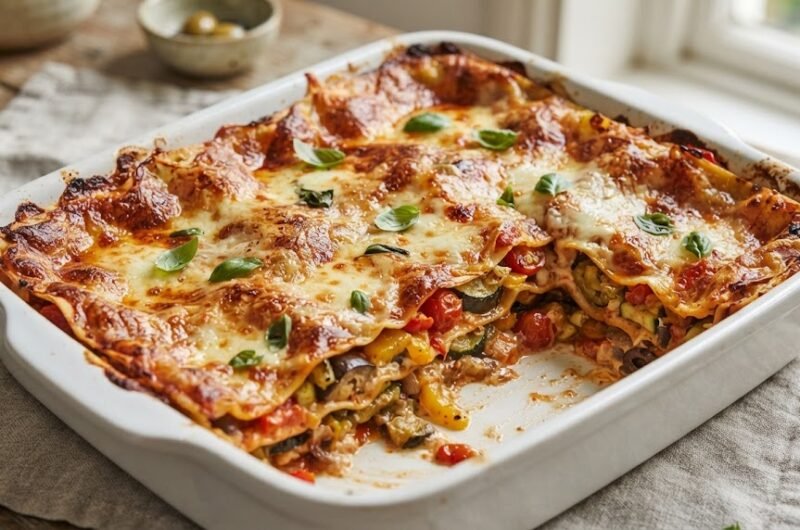
Her Roasted Mediterranean Vegetable Lasagne combines roasted aubergine, courgettes, tomatoes, pepper and onion with spinach lasagne sheets, a simple Parmesan white sauce, mozzarella, olives and capers.
Ingredients for Delia Smith Vegetable Lasagne
For 4–6 servings, you will need:
For the vegetable filling
- About 9 sheets of spinach lasagne that do not require pre-cooking
- 1 small aubergine
- 2 medium courgettes
- 450g cherry tomatoes, skinned
- 1 small yellow pepper
- 1 large onion
- 2 fat cloves garlic
- 2 tablespoons fresh basil
- 3 tablespoons extra virgin olive oil
- 50g pitted black olives
- 1 heaped tablespoon capers
- 75g grated mozzarella
- Salt and freshly milled black pepper
For the white sauce
- 35g plain flour
- 40g butter
- 570ml milk
- 1 bay leaf
- Freshly grated nutmeg
- 3 level tablespoons freshly grated Parmesan
- Salt and freshly milled black pepper
For the topping
- 1 level tablespoon freshly grated Parmesan

How to make Delia’s Roasted Vegetable Lasagne
Prepare the Vegetables
Start by preparing the aubergine and courgettes.
Cut them into roughly 2.5cm pieces, leaving the skins on. Toss them with salt and leave them in a colander for about an hour, weighted down with a plate. This draws out some of their liquid.
After the resting period, squeeze away any remaining moisture and dry the vegetables thoroughly.
This step is worth doing carefully. Excess moisture can make a vegetable lasagne loose and watery.
Prepare the tomatoes, pepper and onion while the aubergine and courgettes are resting.
The tomatoes need to be skinned before roasting. Once all the vegetables are prepared, place them in a large shallow roasting tin.
Add the crushed garlic, torn basil and olive oil. Season with salt and freshly ground black pepper, then toss everything together so the vegetables are lightly coated.
Roast the Mediterranean Vegetables
Preheat the oven to 240°C, 475°F or Gas Mark 9.
Place the roasting tin on the highest shelf and cook the vegetables for approximately 30–40 minutes.
You are looking for vegetables that are tender and visibly browned around the edges rather than pale and simply steamed.
Give the vegetables enough room in the roasting tin. If they are packed too tightly, they will release steam and cook more slowly instead of developing those desirable roasted edges.
Once they are ready, remove the vegetables from the oven and stir through the chopped black olives and capers.
At this point, the vegetable mixture should smell intensely savoury, with the sweetness of roasted tomatoes and onions balanced by the sharper capers and olives.
Make the Parmesan White Sauce
While the vegetables are roasting, prepare the white sauce.
Melt the butter in a saucepan and incorporate the flour to make a smooth roux. Gradually work in the milk, whisking continuously so that the sauce remains smooth.
Add the bay leaf and a little freshly grated nutmeg.
Continue cooking over medium heat until the sauce comes to the boil and thickens. Once it has thickened, reduce the heat and allow it to cook gently for another couple of minutes.
Remove the bay leaf and stir in the grated Parmesan.
Taste the sauce and adjust the seasoning with salt and freshly milled black pepper.
A smooth sauce is important here. If the sauce is too thin, the lasagne can become runny. If it is excessively thick, it will be difficult to spread evenly between the layers.
Assemble the Lasagne
Once the vegetables and sauce are ready, reduce the oven temperature to 180°C, 350°F or Gas Mark 4.
Use the specified heatproof baking dish and begin with a layer of white sauce.
Follow this with roughly one-third of the roasted vegetable mixture, then one-third of the mozzarella.
Add a single layer of lasagne sheets.
Continue building the lasagne in the same general pattern, distributing the ingredients as evenly as possible.
Finish with a layer of white sauce and sprinkle the remaining Parmesan over the surface.
The pasta should be covered properly with sauce. Exposed pasta can become dry or hard during baking.
Don’t worry if the layers look slightly rustic. A vegetable lasagne does not need perfectly geometric layers to bake beautifully.
Bake Until Golden and Bubbling
Place the assembled lasagne in the oven and bake for approximately 25–30 minutes.
The top should become golden and crusty, while the edges should be bubbling gently.
Once baked, give the lasagne a short rest before serving. This makes it easier to portion and allows the layers to settle slightly.
If you cut into it immediately, the sauce and vegetable juices may run more freely.

If you enjoy classic baked pasta dishes, you may also like our lasagne al forno, which offers a traditional meat-based alternative to this vegetable version.
Important Tips for the Best Vegetable Lasagne
Do not skip the vegetable roasting stage
Roasting is what gives this recipe much of its character. It concentrates the flavour of the vegetables and creates browned edges that you cannot achieve as easily by simply simmering them.
Dry the aubergine and courgettes properly
After salting, remove as much moisture as possible before roasting. Damp vegetables are more likely to steam.
Avoid overcrowding the roasting tin
Spread the vegetables out in a generous layer. If necessary, use a larger roasting tin rather than piling everything into a small one.
Make the white sauce smooth
Whisk gradually as the milk is added. This helps prevent lumps and gives you a sauce that spreads easily between the layers.
Season each component
The pasta itself is fairly mild, so the vegetables and white sauce need enough seasoning. Remember that olives, capers and Parmesan are already salty, so taste before adding too much additional salt.
Let the lasagne rest
A few minutes of resting makes the finished dish easier to serve and gives the creamy sauce time to settle around the pasta and vegetables.
Can You Make this Lasagne Ahead?
Yes. This is one of the useful qualities of the recipe.
The components can be prepared ahead, and the assembled dish can be kept chilled before baking. Delia Smith’s recipe is particularly suited to advance preparation, making it practical when you are feeding guests or planning a family meal.
If you assemble the lasagne in advance, keep it refrigerated and make sure it is properly covered.
When preparing it for later cooking, allow for the fact that a thoroughly chilled dish may take longer to heat through than one going into the oven while still warm.
For food safety, avoid leaving the assembled lasagne sitting at room temperature for extended periods.
Vegetable Lasagne Variations and Substitutions
There is some flexibility in a vegetable lasagne, although changing the vegetables will naturally alter the character of the finished dish.
A red pepper can be used in place of the yellow pepper if that is what you have available. The important thing is to retain vegetables that roast well and complement the Mediterranean flavours.
You can also use ordinary lasagne sheets instead of spinach sheets if spinach pasta is unavailable. Choose sheets that are suitable for the cooking method and follow the packet instructions where necessary.
For a vegetarian version, pay attention to the Parmesan. Traditional Parmesan is made using animal-derived rennet, so vegetarians may prefer a suitable vegetarian Parmesan-style cheese.

Can You Freeze Vegetable Lasagne?
Cooked lasagne can be frozen for up to three months once it has been baked, cooled and well wrapped.
Delia advises against freezing it at the ready-to-bake stage. For longer-term storage, baking it first is therefore the preferred approach.
When reheating a frozen cooked lasagne, make sure the centre is thoroughly hot before serving.
When planning a larger meal, this make-ahead quality can be useful alongside other traditional dishes. For example, our leek and potato soup makes another comforting vegetarian option when you want to build a meat-free menu.
For best results, divide a large lasagne into practical portions before freezing. Smaller portions generally reheat more evenly and are convenient for individual meals.
What to Serve With Vegetable Lasagne
This lasagne is rich enough to work as the centrepiece of a meal without requiring many side dishes.
A simple green salad is an excellent accompaniment. Crisp lettuce with a fresh, lemony dressing provides a useful contrast to the warm, creamy lasagne.
You could also serve steamed green vegetables if you want something more substantial alongside it.

If you are serving several courses, keeping the sides relatively simple is best. Another substantial potato dish, such as dauphinoise potatoes, is delicious in its own right but may be too rich alongside a creamy lasagne.
Common Problems and How to Fix Them
Watery lasagne. This usually comes down to underdone vegetables or a tomato sauce that hasn’t reduced enough. Cook both a little longer than feels necessary; the sauce should be thick, not soupy.
Lumpy béchamel. Adding the milk too quickly is the usual culprit. Pour it in gradually and whisk continuously, and it will stay smooth.
Dry or hard pasta edges. This happens when sheets aren’t fully covered in sauce. Push edges down into the sauce as you layer, and make sure the final béchamel layer reaches every corner.
Bland flavour. Vegetable lasagne needs proper seasoning at every stage, not just at the end. Taste the tomato sauce and the béchamel separately before assembling, since the pasta will absorb a fair amount of flavour as it bakes.
Overcrowded layers. It’s tempting to pile in as much filling as possible, but too much sauce between too few pasta sheets makes for a loose, hard-to-serve lasagne. Aim for three even layers of pasta rather than cramming everything into two.
Frequently Asked Questions
Do you need to pre-cook the lasagne sheets?
The original recipe specifies spinach lasagne sheets that do not require pre-cooking. If you substitute another type of pasta, check its packaging because preparation requirements can differ.
Can I make vegetable lasagne two days ahead?
Yes, the published guidance indicates that the assembled but unbaked lasagne can be kept chilled for a couple of days, with chilling preferred to freezing for that short period.
Can vegetable lasagne be frozen?
Yes. The published guidance recommends freezing the lasagne after it has been cooked, cooled and properly wrapped, for up to three months. It advises against freezing the assembled dish before baking.
What vegetables are in Delia Smith’s vegetable lasagne?
The recipe uses aubergine, courgettes, cherry tomatoes, yellow pepper and onion, together with garlic and fresh basil. Black olives and capers are added to the roasted vegetables before assembly.
What sauce does Delia Smith use in her vegetable lasagne?
The recipe uses a classic white sauce made with butter, plain flour and milk. Bay leaf, nutmeg and Parmesan provide additional flavour.
Can I make this recipe vegan?
Yes, with a few swaps. Use a plant-based butter and dairy-free milk for the béchamel, along with a vegan hard cheese alternative, and choose an egg-free pasta if needed. The method stays exactly the same.
Final Thoughts
Delia Smith’s vegetable lasagne works because it gives the vegetables proper attention rather than treating them simply as filler between layers of pasta.
Roasting brings out their sweetness and creates a deeper flavour, while the Parmesan white sauce adds the creamy element that makes a baked lasagne so comforting.
Serve it with a simple green salad and a fresh dressing, and you have a complete meal that feels generous without needing elaborate extras.
Delia Smith Vegetable Lasagne Recipe
Course: Main CourseCuisine: British4-6
servings1
hour15
minutes1
hour15
minutes550
kcal2
hours30
minutesA hearty Mediterranean-style vegetable lasagne made with roasted aubergine, courgettes, tomatoes, pepper and onion, layered with spinach lasagne sheets, Parmesan white sauce and mozzarella. Black olives, capers, garlic and fresh basil add extra savoury flavour.
Ingredients
For the vegetable filling:
9 sheets spinach lasagne, no-pre-cooking required
1 small aubergine
2 medium courgettes
450g cherry tomatoes, skinned
1 small yellow pepper
1 large onion
2 fat cloves garlic, crushed
2 tablespoons fresh basil
3 tablespoons extra virgin olive oil
50g pitted black olives
1 heaped tablespoon capers
75g grated mozzarella
Salt, to taste
Freshly milled black pepper, to taste
For the white sauce:
35g plain flour
40g butter
570ml milk
1 bay leaf
Freshly grated nutmeg
3 level tablespoons freshly grated Parmesan
Salt, to taste
Freshly milled black pepper, to taste
For the topping:
1 level tablespoon freshly grated Parmesan
Directions
- Cut the aubergine and courgettes into roughly 2.5cm pieces. Toss with salt and leave in a colander for about 1 hour, weighted with a plate.
- Squeeze out excess moisture and dry the vegetables thoroughly.
- Preheat the oven to 240°C/475°F/Gas Mark 9.
- Prepare the tomatoes, yellow pepper and onion. Place all the vegetables in a large shallow roasting tin.
- Add the crushed garlic, fresh basil and olive oil. Season with salt and black pepper, then toss everything together.
- Roast on the highest shelf for 30–40 minutes, until the vegetables are tender and browned around the edges.
- Remove the vegetables from the oven and stir through the chopped black olives and capers.
- Meanwhile, make the white sauce. Melt the butter in a saucepan and stir in the flour to make a smooth roux.
- Gradually add the milk, whisking continuously. Add the bay leaf and freshly grated nutmeg.
- Bring the sauce to the boil, stirring until thickened. Reduce the heat and cook gently for another couple of minutes.
- Remove the bay leaf and stir in the Parmesan. Season with salt and black pepper.
- Reduce the oven temperature to 180°C/350°F/Gas Mark 4.
- In a heatproof baking dish approximately 23 x 23 x 5cm, begin with a layer of white sauce.
- Add about one-third of the roasted vegetables and one-third of the mozzarella, followed by a layer of lasagne sheets.
- Repeat the layers, distributing the vegetables, mozzarella, sauce and pasta evenly.
- Finish with a layer of white sauce and sprinkle the remaining Parmesan over the top.
- Bake for 25–30 minutes, until golden on top and bubbling around the edges.
- Allow the lasagne to rest for a few minutes before serving.
Notes
- Do not overcrowd the roasting tin, as the vegetables need space to roast rather than steam.
- Dry the salted aubergine and courgettes well before roasting to help prevent a watery lasagne.


