



If you enjoy traditional British comfort food, Delia Smith’s Liver and Bacon Casserole Recipe is the sort of dinner worth keeping in your repertoire. It combines tender lamb’s liver with smoky bacon, onion and a rich tomato-based gravy, then finishes gently in the oven.
The recipe is straightforward, economical and full of savoury flavour. The important part is not to overcook the liver while browning it. A quick sear gives it colour, while the covered casserole allows it to finish cooking gently in the sauce.
Ingredients Needed
You only need a handful of ingredients for this liver and bacon casserole.
- 563g lamb’s liver, cut into bite-sized pieces
- 138g smoked bacon, chopped
- 1¼ medium onions, chopped
- 500g chopped tomatoes (about 1¼ × 400g tin)
- 1¼ tablespoons Worcestershire sauce
- 344ml ham or beef stock
- 2½ tablespoons plain flour, seasoned with salt and pepper
- A little oil, for frying
How to Make Delia Smith Liver and Bacon Casserole
1. Heat the oven
Preheat the oven to 180°C, 160°C fan, or Gas Mark 4.
Have your casserole dish ready before you begin. Once the sauce is hot, the casserole can go straight into the oven.
2. Cook the bacon and onion
Heat a little oil in a large frying pan over medium heat.
Add the chopped bacon and onion. Cook for several minutes, stirring occasionally, until the onion has softened and the bacon has released some of its fat.
You do not need to make the bacon extremely crisp. The aim is to develop flavour and soften the onion.
Transfer the bacon and onion to the casserole dish.
3. Prepare the liver
Cut the lamb’s liver into reasonably sized pieces. Keeping the pieces fairly similar in size helps them cook at roughly the same rate.
Put the seasoned flour into a shallow bowl and lightly coat the liver.
Shake off excess flour. You want a thin coating rather than a thick layer.
If the liver is particularly wet, pat it gently with kitchen paper before flouring. Excess moisture can make browning more difficult.
4. Quickly brown the liver
Add a little more oil to the frying pan and increase the heat to medium-high.
Add the floured liver in a single layer where possible. Brown it quickly, around 1–2 minutes per side.
The liver does not need to be cooked through at this point.
This is one of the most important stages of the recipe. Cooking the liver completely in the frying pan before putting it into the casserole can leave you with a firmer, tougher result.
Once browned, transfer the liver to the casserole dish with the bacon and onion.
5. Make the tomato gravy
There should be plenty of flavour left in the frying pan.
Sprinkle in any remaining seasoned flour and cook it briefly. Gradually add the stock, stirring as you go and scraping the browned pieces from the bottom of the pan.
Those browned bits add useful flavour to the gravy.
Add the chopped tomatoes and Worcestershire sauce. Stir well and bring the mixture to a gentle boil.
The sauce should look reasonably thick but still pour easily. It will continue to develop and thicken slightly during the oven cooking.
6. Assemble and bake
Pour the hot tomato gravy over the liver, bacon and onion.
Cover the casserole securely with its lid.
Place it in the preheated oven and cook for approximately 45 minutes.
The gentle, covered cooking allows the liver to finish cooking while the flavours come together.
When ready, the casserole should be piping hot and the gravy should be rich and savoury.
7. Serve immediately
Liver is best served straight away.
Spoon the casserole into warm bowls and make sure each serving gets plenty of gravy.
Creamy mashed potato is the classic accompaniment. Crusty bread also works particularly well if you want something simple for soaking up the sauce.

Common Mistakes and How to Avoid It
Overcooking the liver. This is the single biggest reason people are put off liver. Once it turns from pink to grey-brown and firm, it’s past its best. Aim for tender, not falling apart.
Skipping the initial sear. Browning the liver first, even briefly, builds flavour into the gravy through the browned bits left in the pan. Adding raw liver straight to the sauce misses this step.
Using thin, watery stock. Since the sauce only has a handful of ingredients, a weak stock will leave the whole dish tasting flat. A stock cube dissolved properly, or good homemade stock, makes a noticeable difference.
Cooking on too high a heat. Liver toughens quickly under intense heat. A gentle simmer or moderate oven is what keeps it soft.
Can You Change the Ingredients?
There is some flexibility with liver and bacon casserole.
Lamb’s liver can be replaced with another type of liver if that is what you have available. However, different varieties have noticeably different flavours and textures, so the finished dish will not be identical.
Beef liver generally has a stronger flavour. Pig’s liver is another possibility.
The stock can also be changed. Ham stock works particularly well alongside smoked bacon, while beef stock gives a deeper, robust flavour.
For extra vegetables, sliced mushrooms or diced carrots can be cooked with the onion before the casserole is assembled. These additions change the character of the dish but can make it a more substantial one-pot dinner.
Fresh thyme or a bay leaf can also be used if you want additional herbal notes.
If you enjoy hearty British casseroles, this style of meal also pairs naturally with other traditional favourites such as a comforting cottage pie.
What to Serve With Liver and Bacon Casserole
Mashed potato is probably the easiest choice. The creamy texture works beautifully with the rich tomato gravy.
For something lighter, serve the casserole with boiled new potatoes.
Green vegetables provide a useful contrast to the richness of the dish. Try:
- Steamed cabbage
- Kale
- Garden peas
- Green beans
- Broccoli
Crusty bread is another excellent option, particularly when you want a quick weekday meal without making potatoes.
For a more traditional-style plate, combine the casserole with mashed potatoes and two green vegetables.

For something with a bit more spice, a chilli con carne or a beef stroganoff are worth keeping in mind for the following night, since neither shares much overlap with the flavours here.
How to Store Leftovers
Liver is generally best eaten fresh because its texture can become firmer after refrigeration and reheating.
If you do have leftovers, transfer them to a clean airtight container and refrigerate them promptly.
The researched recipe guidance suggests using refrigerated leftovers within two days. Reheat them gently on the hob or in the oven until thoroughly hot.
Try not to repeatedly reheat the same portion. Divide leftovers into individual servings before refrigerating if you expect to eat them separately.
Microwave reheating can be convenient, but liver can become rubbery if it is heated too aggressively.
Can You Freeze Liver and Bacon Casserole?
The casserole can be frozen, although the texture of the liver may not be quite as good after thawing.
If freezing, cool the casserole promptly, divide it into suitable portions and store it in airtight freezer containers.
The researched version gives a freezer period of up to three months.
Thaw frozen portions in the refrigerator before reheating. Heat gently until piping hot throughout.
For the best texture, however, cooking only the quantity you expect to eat is preferable.
Can You Make It Ahead?
Yes.
You can prepare the bacon and onion, coat and quickly brown the liver, and make the gravy in advance.
Allow the prepared components to cool appropriately, then refrigerate them until needed.
When you are ready to cook, assemble the casserole and place it into the oven. If the ingredients are starting from refrigerator temperature rather than warm, allow some additional cooking time and check that the centre is thoroughly hot before serving.
For the best result, avoid preparing the liver unnecessarily far in advance.

Nutritional Information — Per Serving
- Calories: ~430 kcal
- Protein: ~35 g
- Carbohydrates: ~20 g
- Fat: ~23 g
- Saturated Fat: ~7 g
- Cholesterol: ~400 mg
- Sodium: ~900 mg
- Fiber: ~3 g
- Sugars: ~6 g
Frequently Asked Questions
How long does liver and bacon casserole take to cook?
The oven cooking time for this version is about 45 minutes at 180°C, 160°C fan, or Gas Mark 4. Including preparation and browning, the whole dish takes approximately one hour.
What type of liver is best for liver and bacon casserole?
Lamb’s liver is a good choice for this recipe because it has a relatively mild flavour and tender texture. Beef or pig’s liver can also be used, although the flavour will be different.
Should liver be soaked in milk before cooking?
It is not essential. Some people soak liver in milk for around 30 minutes when they want to soften its strong flavour. If you do this, pat the liver thoroughly dry before flouring and cooking.
Why is my liver tough?
Overcooking is the most likely reason. Liver does not benefit from being aggressively fried for a long time. Brown it quickly and let it finish cooking gently in the covered casserole.
Can I use beef stock instead of ham stock?
Yes. Ham stock gives a particularly savoury result alongside smoked bacon, but beef stock is a suitable alternative and is specifically included in the researched version of the recipe.
Can I make liver and bacon casserole in a slow cooker?
A slow-cooker adaptation is possible. The liver and bacon can be browned first, followed by the onion and sauce, before everything is transferred to the slow cooker.
However, slow cooking changes the texture and can cause the liver pieces to break down more than they do in the oven method. A current recipe adaptation suggests around 5–6 hours on Low or 3–4 hours on High.
What vegetables go well with liver and bacon?
Cabbage, peas, kale, green beans and broccoli all work well. Their freshness and slight sweetness provide a good contrast to the rich bacon and gravy.
Can I serve liver and bacon casserole with rice?
You can, although mashed potato is a more natural match for this particular gravy. Rice will work if you prefer it, especially if you want a lighter-feeling accompaniment.
Final Thoughts
Delia Smith Liver and Bacon Casserole Recipe is a good example of how a small number of everyday ingredients can create a deeply savoury meal.
The key is treating the liver gently. Brown it quickly rather than cooking it through in the frying pan, then let the covered casserole finish the job.
The combination of lamb’s liver, smoked bacon, onion, tomatoes, Worcestershire sauce and stock creates a rich gravy that is especially good with mashed potato.
It is an old-fashioned style of British dinner, but its straightforward preparation still makes sense for a home kitchen today.
For another comforting meal from the same general tradition, you may also enjoy a Delia’s cottage pie, while a slow cooker chicken casserole offers another practical one-pot option.
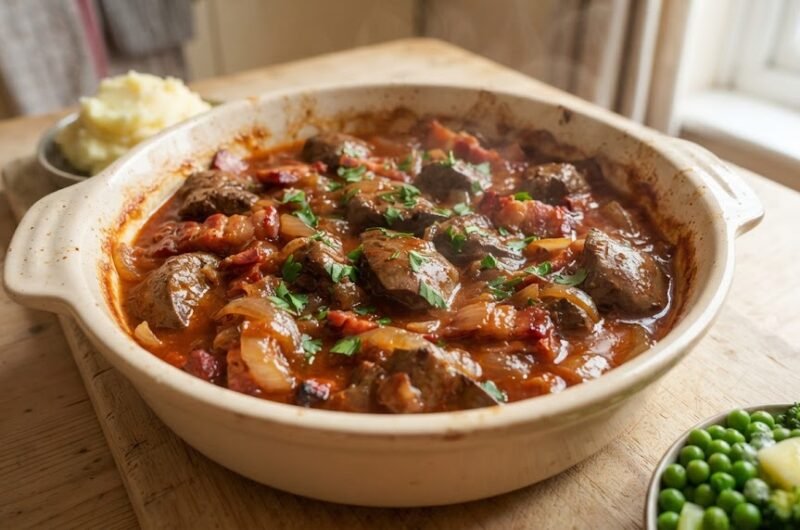
Delia Smith Liver and Bacon Casserole Recipe
Course: Main CourseCuisine: British5
servings15
minutes45
minutes430
kcal1
hourA comforting British casserole made with tender lamb’s liver, smoky bacon, onion and chopped tomatoes, finished in a rich, savoury gravy. It is best served hot with creamy mashed potatoes and green vegetables.
Ingredients
560g lamb’s liver, cut into bite-sized pieces
140g smoked bacon, chopped
1¼ medium onions, chopped
500g chopped tomatoes
1¼ tablespoons Worcestershire sauce
350ml ham or beef stock
2½ tablespoons plain flour
Salt and freshly ground black pepper, to taste
A little vegetable oil, for frying
Directions
- Preheat the oven to 180°C, 160°C fan, or Gas Mark 4.
- Heat a little oil in a large frying pan. Add the bacon and onion and cook until the onion softens and the bacon releases its fat.
- Transfer the bacon and onion to a large ovenproof casserole dish.
- Coat the pieces of lamb’s liver lightly in the seasoned flour.
- Add a little more oil to the frying pan and quickly brown the liver for about 1–2 minutes per side. Do not cook it through at this stage.
- Transfer the browned liver to the casserole dish.
- Add the remaining flour to the frying pan and cook briefly. Gradually pour in the stock, stirring and scraping up the browned pieces from the bottom of the pan.
- Add the chopped tomatoes and Worcestershire sauce. Stir well and bring the sauce to a gentle boil.
- Pour the hot sauce over the liver, bacon and onion.
- Cover the casserole with a lid and bake for approximately 45 minutes, until thoroughly hot and the gravy has thickened.
- Serve immediately with mashed potatoes and your choice of green vegetables.
Notes
- Avoid overcooking the liver during the initial browning stage, as this can make it tough.
- A light coating of flour is enough; shake off any excess before frying.
- Ham stock gives a particularly savoury flavour, but beef stock can also be used.


