


 Rosie Fielding
 Few desserts capture a British summer table quite like a pavlova, and Delia Smith’s version has become one of the most trusted methods for getting it right.
Delia Smith built her reputation on recipes that actually work in a home kitchen, and her strawberry pavlova is no exception. It relies on a handful of everyday ingredients and a slow, patient method rather than any clever tricks.
This dessert has a reputation for being temperamental, but that’s mostly down to rushing it. Follow the method properly, and you end up with a meringue that’s crisp on the outside and soft, almost marshmallowy, in the middle, topped with billowy cream and whatever fruit is in season.
Ingredients to make Strawberry Pavlova
A pavlova doesn’t need a long ingredients list, but each item does a specific job.
For the meringue base:
- 3 large egg whites (about 100g)
- 175g caster sugar
- 1 tsp white wine vinegar
- 1 tsp cornflour
For the topping:
- 300ml double cream (or 150g mascarpone mixed with 150ml fromage frais)
- 400g fresh strawberries, hulled and halved
- 1 tbsp icing sugar, for dusting

Equipment Needed
You don’t need anything unusual for this recipe, but a few things make the job much easier.
- A large, completely clean and grease-free mixing bowl. Even a trace of fat will stop the egg whites whisking up properly. I use this mixing bowl for all my baking recipes.
- An electric hand whisk or stand mixer. Whisking three or four egg whites to stiff peaks by hand is possible, but genuinely hard work.
As an Amazon Associate, I earn from qualifying purchases.
Steps to make Delia Smith Pavlova
1. Prepare your oven and tray
Preheat the oven to 150°C (130°C fan, gas mark 2) and give it time to come fully up to temperature before you start whisking. Line a baking sheet with baking parchment and draw a 20cm circle on it, using a plate or cake tin as a guide.
Flip the parchment over so the mixture doesn’t sit directly on the pencil mark, and dab a little of the meringue mixture under each corner once you get to it, to help hold the paper in place.
2. Whisk the egg whites
Make sure your bowl is completely clean and dry, with no trace of grease, water, or egg yolk, as any of these will stop the whites whisking up properly.
Add the 3 egg whites and whisk on a low speed to begin with, then gradually increase to high speed as they start to turn frothy and white.
Keep whisking until the whites hold stiff, glossy peaks that stand up on their own when you lift the whisk out, rather than flopping over.
3. Add the sugar gradually
With the whisk still running on medium-high speed, add the 175g caster sugar one tablespoon at a time. Whisk for a good ten to fifteen seconds after each spoonful before adding the next, so the sugar has time to dissolve properly rather than sitting in the mixture as gritty crystals.
This whole step can take several minutes, and it’s worth being patient with it. By the end, the mixture should look thick, smooth and glossy, almost like shaving foam, and you shouldn’t be able to feel any graininess if you rub a little between your fingers.
4. Fold in the vinegar and cornflour
Add the 1 tsp white wine vinegar and 1 tsp cornflour to the bowl. Using a large metal spoon or a spatula, fold them through gently with a light, scooping motion rather than stirring or beating.
5. Shape the meringue
Spoon the mixture onto the prepared parchment, working within the 20cm circle you marked out. Use the back of the spoon or a palette knife to build the sides up slightly higher than the middle, so you end up with a shallow well in the centre once it’s baked.
This dip is where the cream and fruit will sit later, so don’t smooth it out completely flat.
6. Bake
Place the tray in the oven and immediately turn the temperature down to 140°C (120°C fan, gas mark 1). Bake for 1 hour to 1 hour 15 minutes, without opening the oven door during this time.
You’ll know it’s ready when the outside is pale, firm to a light touch, and sounds slightly hollow if you tap the base gently.
7. Cool completely in the oven
Turn the oven off once baking time is up, but leave the pavlova exactly where it is, with the door closed, rather than taking it out straight away.
Let it cool inside the switched-off oven for at least 2 hours, or ideally overnight if you’re making it a day ahead. This slow, gradual cooling is what stops the shell cracking or sinking in the middle.
8. Add the topping
Once the meringue is completely cold, carefully lift it off the parchment and onto a serving plate or cake stand. Whip the 300ml double cream to soft, floppy peaks (or beat together the mascarpone and fromage frais until smooth), then spoon it into the dip in the centre of the meringue.
Arrange the 400g strawberries on top, cut side up if halved, and finish with a light dusting of the 1 tbsp icing sugar. Serve straight away, sliced into wedges with a sharp knife.

Important Tips for a Perfect Pavlova
A handful of small details make a genuine difference here.
- Make sure your bowl and whisk are completely free of grease. Even a smear of butter or a trace of egg yolk can stop egg whites whipping properly. Wiping the bowl with a little vinegar on kitchen paper before you start is a reliable way to be sure.
- Use eggs at room temperature. They’ll whisk up with greater volume than cold eggs straight from the fridge.
- Don’t rush the sugar. Adding it too quickly is the single biggest reason home cooks end up with a weeping, syrupy meringue instead of a stable one.
- Resist opening the oven door while it bakes. A blast of cold air can cause the structure to collapse.
- Only add the cream and fruit shortly before serving. Left too long, moisture from the topping will soften the crisp shell.
Common Pavlova Problems and How to Avoid Them
Why did my pavlova crack?
Cracking can happen when the meringue cools too quickly or when the oven temperature is higher than expected.
Allowing the pavlova to cool gradually in the switched-off oven can help reduce dramatic cracking. Even with careful preparation, a few cracks are completely normal.
Why is my meringue sticky or weeping?
Weeping can occur when the sugar has not dissolved sufficiently or when the meringue absorbs moisture.
Add the sugar gradually and whisk until the mixture is smooth and glossy. Humid weather can also make meringue more difficult to keep crisp.
Why did the egg whites not whip properly?
The most common reason is contamination with fat or egg yolk.
Use a thoroughly clean bowl and beaters. Make sure the egg whites are separated carefully, and avoid adding any yolk.
Why did my filling become runny?
Mascarpone can loosen when overmixed, particularly if it becomes warm.
Use chilled ingredients and mix only until the filling is smooth and combined.
What if my pavlova is too brown?
The oven was probably too hot. Ovens vary, so an oven thermometer can be useful if you regularly bake meringues.
Pavlova should remain pale rather than develop the deep colour associated with ordinary baked goods.
Variations
Pavlova is a genuinely flexible dessert once you’ve got the base right.
Fruit: Strawberries are the traditional pairing, but raspberries, blackberries, and redcurrants all work beautifully in summer. In colder months, poached rhubarb, stewed apple, or passion fruit and mango bring a nice change of pace.
Cream filling: A simple whipped double cream is classic, but mixing in mascarpone gives a denser, richer result that holds its shape for longer. Fromage frais lightens things up if you want something less heavy.
Individual pavlovas: Instead of one large circle, you can pipe or spoon the mixture into smaller nests for individual portions, which also cuts the baking time down.
Flavoured meringue: A little vanilla extract or a spoonful of cocoa powder folded through the mixture before baking can add a subtle twist without overcomplicating things.
Chocolate pavlova: Fold a tablespoon or two of sifted cocoa powder into the meringue mixture along with the vinegar and cornflour, then top with cream and fruit as usual, or with grated chocolate and a drizzle of chocolate sauce for a richer finish.
Lemon curd pavlova: Swirling lemon curd through the cream, or spooning it over the top, gives a sharper, tangier take on the classic. It’s a popular enough variation in its own right that it deserves a full recipe of its own.
How to serve Strawberry Pavlova
Pavlova is best served as the centrepiece of the table rather than plated up individually in the kitchen. Bring the whole thing out on a large flat plate or a cake stand and let people help themselves.
It pairs nicely with a glass of chilled dessert wine or sparkling rosé for an adult gathering, or a homemade lemonade for a lighter, non-alcoholic option. A jug of fruit purée or coulis on the side is a nice touch too, letting guests add as much or as little as they like.

How to Store Leftover Pavlova
Once assembled, pavlova is best eaten as soon as possible.
Leftovers can be refrigerated, but the meringue will soften as it sits beneath the cream and fruit. Cover it loosely and eat within a day for the best quality.
The unfilled meringue shell keeps better than the finished dessert, provided it is stored in a dry, airtight container at room temperature.
Pavlova is not a dessert that benefits from reheating. The texture is its defining feature, and heating would damage both the meringue and the creamy topping.
Can we make it ahead of time?
This is where pavlova really earns its place as a good dinner-party dessert. The meringue base can be baked a day or two in advance and stored in an airtight container once fully cooled.
Whip the cream and prepare the fruit separately closer to serving time, then assemble everything just before you bring it to the table. This way, you get all the benefit of having done the fiddly part in advance, without the shell losing its crispness.
If you’re planning ahead for a bigger bake, it’s worth browsing other classic recipes on the site, including this Delia Smith fatless sponge, another dessert that benefits from being made a little in advance.
Nutrition Facts
Approximate values per serving (based on 8 servings, using double cream):
- Calories: 230 kcal
- Carbohydrates: 28g
- Sugar: 26g
- Fat: 13g
- Saturated Fat: 8g
- Protein: 2g
- Fibre: 1g
These figures are estimates and will vary depending on the exact brands used and whether you choose the mascarpone and fromage frais topping instead of double cream.
Frequently Asked Questions
Why did my pavlova crack?
Cracking is usually caused by a sudden change in temperature, either from an oven that’s too hot to begin with, or from taking the pavlova out to cool too quickly. Letting it cool slowly inside the switched-off oven helps prevent this.
Do I need cornflour and vinegar for pavlova?
They’re not strictly essential, but both help. The vinegar adds a touch of acidity that stabilises the egg whites, and the cornflour helps trap a little moisture, giving you that soft, marshmallowy centre rather than a meringue that’s dry all the way through.
Can I use granulated sugar instead of caster sugar?
It’s best avoided if you can help it. Granulated sugar is coarser and takes longer to dissolve, which increases the risk of a grainy or weeping meringue. Caster sugar dissolves far more readily into whisked egg whites.
How do I know when the egg whites are whisked enough?
They should hold stiff, glossy peaks that stand upright when you lift the whisk out, without drooping over or looking dull and grainy. If the mixture still looks wet or slips around the bowl when tilted, it needs more time.
Why is my pavlova hollow in the middle?
This is usually a sign the oven ran a little too hot, or the meringue was left in slightly too long. A gentler, lower oven temperature tends to give a more even result with a proper soft centre rather than a hollow shell.
Can I freeze pavlova?
The unfilled meringue base freezes reasonably well in an airtight container, though it can lose a little of its crispness on thawing. It’s generally better to bake fresh if you have the time, but freezing the base is a reasonable option if you’re planning well ahead. Never freeze pavlova once it’s been topped with cream and fruit.
Final Thoughts
Delia Smith Meringue Pavlova is a good example of how a handful of ordinary ingredients, handled with a bit of patience, can produce something genuinely impressive.
There’s no need for unusual equipment or hard-to-find ingredients here, just a clean bowl, a steady hand with the sugar, and the willingness to let it cool properly before you touch it.
Once you’ve made it a couple of times, the process becomes second nature, and it turns into one of those desserts you can pull together confidently whenever you need something that looks far more difficult than it actually is.
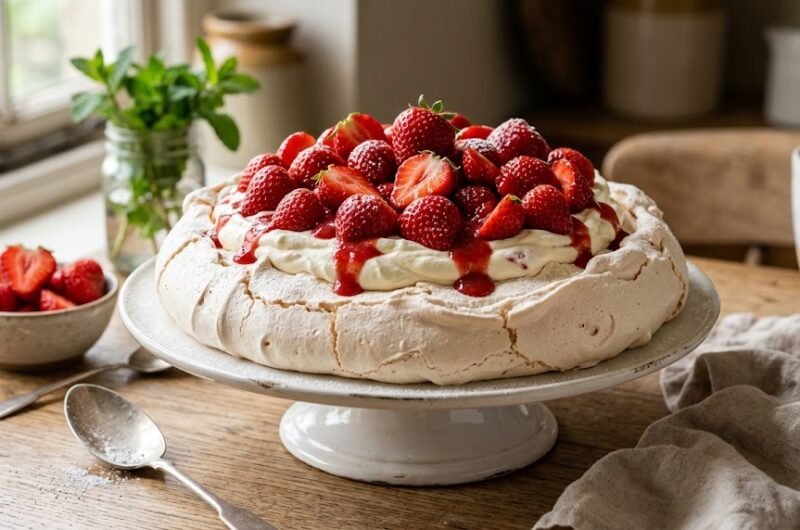
Delia Smith Pavlova Recipe
Course: DessertsCuisine: British6
servings25
minutes1
hour15
minutes230
kcal2
minutes1
hour40
minutesA classic British meringue dessert with a crisp shell and a soft, marshmallowy centre, topped with whipped cream and fresh strawberries.
Ingredients
For the meringue base:
3 large egg whites (about 100g)
175g caster sugar
1 tsp white wine vinegar
1 tsp cornflour
For the topping:
300ml double cream (or 150g mascarpone mixed with 150ml fromage frais)
400g fresh strawberries, hulled and halved
1 tbsp icing sugar, for dusting
Directions
- Preheat the oven to 150°C (130°C fan, gas mark 2). Line a baking sheet with parchment and draw a 20cm circle on it, then flip the parchment over.
- Whisk the egg whites in a clean, dry bowl, starting on low speed and building up to high, until stiff peaks form.
- Add the caster sugar one tablespoon at a time, whisking well after each addition, until thick and glossy.
- Gently fold in the vinegar and cornflour.
- Spoon the mixture onto the parchment within the circle, building the sides slightly higher than the centre.
- Bake, turning the temperature down to 140°C (120°C fan) immediately, for 1 hour to 1 hour 15 minutes.
- Turn the oven off and leave the pavlova inside, door closed, until completely cold — at least 2 hours, or overnight.
- Whip the cream and spoon it into the centre. Top with strawberries and dust with icing sugar just before serving.
Notes
- Make sure the bowl is completely grease-free before whisking the egg whites, or they won’t whip up properly.
- Don’t open the oven door while the pavlova bakes or cools, as sudden temperature changes cause cracking.
- Assemble with cream and fruit only shortly before serving, as the topping softens the shell over time.
- The meringue base can be made 1–2 days ahead and stored in an airtight container at room temperature.


[…] sits comfortably next to lighter bakes such as this fatless sponge or a fruit-based dessert like pavlova, which offer a lighter contrast to the density of the fudge […]