



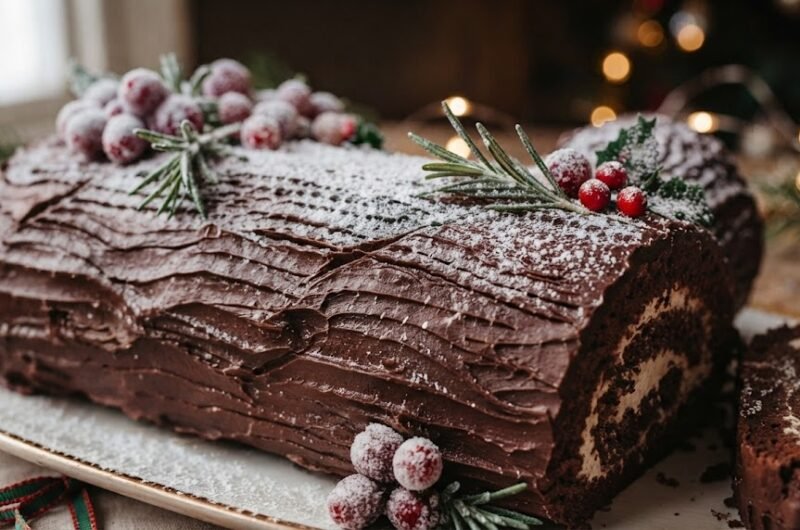
A Delia Smith Yule Log recipe is a wonderful choice when you want a traditional Christmas dessert that looks festive without requiring complicated decoration. This version combines a light flourless chocolate sponge with a rich chocolate filling and softly whipped double cream, then rolls everything together into a classic Yule log shape.
If you have never made a chocolate roulade before, the rolling stage can seem intimidating. The good news is that this type of sponge is forgiving. A few cracks do not ruin the finished dessert; once the log is dusted with icing sugar and sliced, it still looks beautifully festive.
If you have never made a chocolate roulade before, the rolling stage can seem intimidating. The good news is that this type of sponge is forgiving. A few cracks do not ruin the finished dessert; once the log is dusted with icing sugar and sliced, it still looks beautifully festive.
Ingredients Needed
For the sponge:
- 4 large eggs
- 100g caster sugar
- 65g self-raising flour
- 40g cocoa powder
- ½ tsp baking powder
For the filling:
- 300ml double cream
- 1 tbsp icing sugar
- ½ tsp vanilla extract
For the ganache:
- 200g dark chocolate (at least 60% cocoa solids), finely chopped
- 200ml double cream
Icing sugar, for dusting
Step-by-Step Method to make Delia Smith Yule Log
1. Prepare the tin and oven
Preheat the oven to 200°C (180°C fan/Gas 6). Grease the Swiss roll tin and line it with baking parchment, pushing the paper into the corners so it sits slightly proud of the tin’s edges.
2. Whisk the eggs and sugar
Whisk the eggs and caster sugar together for several minutes, until the mixture is pale, thick and has roughly doubled in volume. It should leave a visible trail on the surface when you lift the beaters — this stage does most of the work of aerating the sponge, so don’t rush it.
3. Fold in the dry ingredients
Sift the flour, cocoa powder and baking powder over the whisked eggs. Using a large metal spoon or spatula, fold everything together gently, cutting through the mixture rather than stirring, to keep as much air in as possible.
4. Bake
Pour the batter into the prepared tin and spread it evenly into the corners. Bake for 8–10 minutes, until the sponge springs back when lightly pressed and is just coming away from the sides of the tin.
5. Roll the sponge while warm
Lay a clean tea towel on the counter and dust it lightly with caster sugar or cocoa powder. Turn the warm sponge out onto the towel and peel away the lining paper. Starting from a short end, roll the sponge up with the towel inside it, then leave it to cool completely in this rolled shape. This step is what trains the sponge to roll without cracking later.
6. Whip the filling
While the sponge cools, whip the double cream with the icing sugar and vanilla extract until it holds soft peaks. Be careful not to over-whip; the cream should still look smooth and spreadable, not grainy.
7. Fill and re-roll
Once the sponge is fully cool, carefully unroll it and remove the towel. Spread the whipped cream evenly over the surface, leaving a small border at the far edge. Roll the sponge back up firmly, this time without the towel, using it only to guide the shape.
8. Make the ganache
Heat the 200ml of double cream in a small saucepan until it’s steaming hot but not boiling. Pour it over the chopped dark chocolate and leave for a minute, then stir until completely smooth and glossy. Let the ganache cool and thicken to a spreadable consistency; this can take 20–30 minutes at room temperature, or slightly longer in a cool kitchen.
9. Decorate
Trim the ends of the log neatly, then cover the whole cake in ganache using a palette knife. Drag a fork lengthways through the ganache to create a bark-like texture. Chill for at least an hour before serving, then dust with icing sugar to finish.

How to Stop a Yule Log From Cracking
Cracking is probably the biggest concern when making a chocolate roulade.
The first thing to remember is that a cracked Yule log is not necessarily a failed Yule log.
The sponge is delicate, and small cracks can occur as it cools and rolls.
There are, however, several ways to reduce the problem.
Do not overbake the sponge
A dry sponge is less flexible.
Start checking it around the 20-minute mark. It should feel springy rather than hard.
Keep the egg whites airy
The whipped whites are important to the texture of the flourless sponge.
Fold them gently rather than beating the mixture after they have been incorporated.
Cool it completely before filling
The chocolate filling and cream should not be spread over a warm sponge.
Allow the sponge to cool completely first.
Use the parchment to help roll
Trying to roll the sponge directly with your hands makes it easier to press or tear it.
The parchment gives you leverage and allows you to guide the cake into shape.
Why Did My Yule Log Sink?
A little sinking is expected with this style of flourless sponge.
The cake rises during baking and then loses some of that height as it cools.
However, if it is extremely flat or dense, the egg whites may have lost too much air during mixing.
Overmixing after adding the whites can also make the batter heavier.
Another possibility is underbaking. The sponge needs enough time in the oven to set its structure.
The key is to aim for a sponge that is light, springy and flexible, rather than tall like a conventional sponge cake.

Important Cooking Tips
- Roll the sponge while it’s still warm; a cooled, unrolled sponge is far more likely to crack.
- Don’t skip the resting period once rolled with the towel — it sets the shape and makes the second roll much easier.
- Whip the cream just to soft peaks. Over-whipped cream splits when you spread and roll it.
- Let the ganache thicken properly before spreading. A ganache that’s too runny will slide straight off the sponge.
- Use a sharp, warm knife to slice the log for neat portions — dip it in hot water and wipe dry between cuts.
Variations and Substitutions
This chocolate log takes well to a few sensible changes:
- Chestnut version: Fold sweetened chestnut purée through half the whipped cream filling for a more traditional French bûche de Noël flavour.
- Coffee kick: Add a teaspoon of instant espresso powder to the cream filling for a mocha edge.
- Boozy filling: A tablespoon of orange liqueur or dark rum stirred into the whipped cream adds a festive warmth, though it’s best kept for an adults-only table.
- Milk chocolate ganache: You can use milk chocolate for the coating, though it will set softer and sweeter. Use slightly less cream, or chill it a little longer before spreading.
- Nut-free and simple: Leave the filling and ganache as they are for a straightforward, crowd-pleasing version that suits most dietary needs bar dairy and egg.
Serving Suggestions
A slice of chocolate Yule log is rich enough to stand on its own, but it pairs well with a few simple additions. A spoonful of lightly sweetened whipped cream or a scoop of vanilla ice cream on the side balances the density of the ganache. Fresh raspberries or a handful of pomegranate seeds add welcome sharpness and a festive splash of color on the plate.

For drinks, a strong coffee or a glass of dessert wine both work well alongside the deep chocolate flavour. If you’re serving it as part of a full Christmas spread, a lighter dessert like a pavlova alongside it gives guests a fruitier option too.
How to Store Yule Log
Store leftover Yule log covered in the refrigerator.
The cream filling means this is a dessert that should be treated as a chilled dessert rather than something that can sit on the kitchen counter throughout the day.
For Christmas entertaining, it is sensible to make the dessert close to the time it will be served and keep it refrigerated until needed.
If you are preparing the recipe ahead, avoid adding decorative ingredients that may become wet or spoil until shortly before serving.
Make-Ahead Advice
This is a genuinely good make-ahead dessert, which is part of why it suits Christmas Day so well. Bake and fill the sponge up to two days in advance and keep it wrapped in the fridge. The ganache can also be made a day ahead and gently warmed to a spreadable consistency before use.
Assembling the finished log the day before serving actually improves it: the sponge absorbs a little moisture from the cream overnight, and the ganache has time to firm up fully, making it easier to slice cleanly on the day.
Frequently Asked Questions
Can I make this Yule log ahead of time?
Yes. It’s best made the day before, as resting overnight in the fridge lets the ganache set properly and the sponge soften slightly from the cream, which improves both texture and flavour.
Can I use milk chocolate for the ganache?
You can, though the result will be sweeter and softer. Reduce the cream slightly or chill the ganache for longer so it thickens enough to hold a piped or forked texture.
Why did my sponge crack when I rolled it?
Cracking usually happens when the sponge has cooled before rolling, or has been overbaked and lost moisture. Roll it while still warm, straight from the tin, to train it into shape.
Can I freeze a chocolate Yule log?
Yes, the sponge and cream filling freeze well for up to a month. Freeze it before adding the ganache, then thaw in the fridge and decorate on the day you plan to serve it.
What can I use instead of a Swiss roll tin?
A shallow rectangular baking tray of a similar size will work, but the sponge is more prone to spreading unevenly without the raised sides of a proper Swiss roll tin, so it’s worth using one if you can.
How far in advance can I decorate it?
Once it’s iced, the log keeps its texture for two to three days in the fridge, so decorating it a day before serving is perfectly fine.
Final Thoughts
A chocolate Yule log rewards a little patience rather than any particular skill. Whisk the eggs properly, roll the sponge while it’s warm, and let the ganache thicken before you spread it, and the rest largely takes care of itself.
It’s the kind of bake that looks like the centrepiece of a professional kitchen but is, in practice, well within reach of an ordinary Christmas Eve baking session. Serve it chilled, slice it with a warm knife, and it’s one of those desserts that disappears from the table faster than almost anything else on it. If chocolate desserts are your thing this time of year, Delia’s chocolate mousse is worth adding to the same table.
Delia Smith Yule Log Recipe
Course: DessertCuisine: British8
servings45
minutes10
minutes320
kcal1
hourA light, flourless-style chocolate sponge rolled around softly whipped cream and coated in a rich dark chocolate ganache, textured to resemble tree bark. A classic festive centrepiece that looks impressive but comes together with a straightforward roll-fill-roll method.
Ingredients
For the sponge:
4 large eggs
100g caster sugar
65g self-raising flour
40g cocoa powder
½ tsp baking powder
For the filling:
300ml double cream
1 tbsp icing sugar
½ tsp vanilla extract
For the ganache:
200g dark chocolate (60%+ cocoa solids), finely chopped
200ml double cream
To finish:
Icing sugar, for dusting
Directions
- Preheat the oven to 200°C (180°C fan/Gas 6). Grease and line a 33 x 23cm Swiss roll tin.
- Whisk the eggs and caster sugar until pale, thick and doubled in volume.
- Sift in the flour, cocoa powder and baking powder, and fold in gently.
- Pour into the tin, spread evenly, and bake for 8–10 minutes until springy.
- Turn out onto a sugared tea towel, peel off the parchment, and roll up warm with the towel inside. Leave to cool completely.
- Whip the cream with icing sugar and vanilla to soft peaks.
- Unroll the cooled sponge, spread with cream, and roll back up firmly.
- Heat the cream for the ganache until steaming, pour over the chopped chocolate, and stir until smooth. Cool until spreadable.
- Cover the log in ganache, texture with a fork, chill for at least 1 hour, then dust with icing sugar.
Notes
- Roll the sponge while still warm to prevent cracking.
- Keeps refrigerated for up to 3 days; freezes well before ganaching.
- Let the ganache thicken before spreading, or it will slide off.


