


 Rosie Fielding
 If you are cooking a traditional roast dinner for a crowd, this Delia Smith Yorkshire Pudding For 12 recipe gives you plenty of crisp, golden Yorkshire pudding without changing the character of the original recipe.
Yorkshire pudding is one of those recipes where a few simple details make a big difference. The batter uses plain flour, eggs, semi-skimmed milk and water, while beef dripping provides the rich savoury flavour and very hot cooking fat needed for a good rise.
Delia Smith’s Yorkshire pudding recipes come from her Complete Illustrated Cookery Course, where she publishes versions to serve 4 and to serve 6. For a table of 12, the sensible approach is to double the ingredients and bake in two tins rather than cramming everything into one.
Why You’ll Love This Pudding
This is a straightforward traditional Yorkshire pudding recipe, scaled specifically for a larger gathering.
- Crisp and golden: High heat and smoking-hot fat help create a well-browned outside.
- Soft centre: The combination of milk, water and eggs gives the pudding a tender interior.
- Simple ingredients: There is no need for baking powder or complicated additions.
- Ideal for a roast: The savoury flavour works especially well with roast beef and gravy.
- Easy to scale: The six-person quantities can be doubled without changing the ingredient proportions.
- Useful for entertaining: The batter can be prepared before the final cooking stage, which makes timing a roast dinner easier.
Ingredients You’ll Need
For 12 servings, you will need:
- 350g plain flour (12.3 oz)
- 4 large eggs
- 350ml semi-skimmed milk (11.8 fl oz)
- 220ml water (7.4 fl oz)
- 160g beef dripping (5.6 oz), or 8 tablespoons flavourless vegetable or sunflower oil
- Salt and freshly milled black pepper, to taste

Equipment
Use two flameproof metal tins, each approximately 20 x 26cm and suitable for being placed directly over heat.
The two-tin approach is useful because the doubled mixture can be divided evenly, keeping the batter at a sensible depth. If your tins are not suitable for direct hob heat, do not place them on a burner.
How To Make Delia Smith Yorkshire Pudding For 12 people
1. Make the batter
Sift the flour into a large mixing bowl, holding the sieve reasonably high as you do so. Add salt and freshly milled black pepper, then make a well in the centre.
Break the four eggs into the middle. Begin whisking with an electric hand whisk, gradually drawing flour in from around the edges.
Slowly add the milk and water while continuing to whisk. Keep mixing until the batter is smooth and there are no obvious lumps of flour.
Use a rubber spatula to scrape around the bowl, particularly the base and sides, then give the batter one final brief whisk.
There is no need to leave the batter standing before cooking.
2. Heat the oven and fat
Set the oven to 220°C, 200°C Fan, Gas Mark 7 or 425°F.
Divide the beef dripping between the two tins. Place the tins in the oven for about 10 minutes, allowing the fat to become extremely hot.
The fat should be sizzling and smoking when the batter is ready to be added. This is one of the most important stages for achieving a good rise.
3. Add the batter to the hot tins
Carefully remove one hot tin from the oven.
Place it over high heat on a suitable hob burner and immediately pour half of the batter into the sizzling fat. You should hear an immediate, vigorous sizzle.
Repeat with the second tin and the remaining batter.
Take care when doing this because the combination of very hot fat and wet batter can spit.
4. Bake on a high shelf
Return both tins to the oven as quickly as possible.
Place them on the highest shelves available. If both cannot fit on the same shelf, use the highest and second-highest positions.
Bake for 25–30 minutes.
Avoid opening the oven door during this time. The puddings need a steady, high temperature while they rise and set.
5. Check for a deep golden finish
The Yorkshire puddings should be visibly risen and have a crisp, golden-brown exterior.
The surface should look firm rather than pale or wet. Give them the full cooking time if the centre still appears soft or undercooked.
6. Cut and serve immediately
Remove the puddings from the oven and divide each one into six portions.
Serve while they are hot and crisp, preferably alongside roast beef and plenty of gravy.
If they need to wait briefly before serving, a hot oven or grill can help restore some crispness.

Tips For Making Yorkshire Pudding Successfully
Get the fat properly hot
Warm fat is not enough. The batter needs to hit very hot fat immediately so cooking starts at once.
If the fat has not reached a high enough temperature, the pudding can turn out heavy and pale rather than rising dramatically.
Keep the oven door closed
Avoid checking the puddings repeatedly.
The early part of cooking is particularly important because the batter needs consistent heat to expand and begin setting. Opening the door unnecessarily allows heat to escape.
Use a suitable tin
Because the method involves putting the hot tin directly over high heat when the batter is added, the tin must be designed to withstand direct hob heat.
A normal oven-only baking tray should not be placed on a burner.
Do not overfill the tins
Dividing the doubled mixture between two tins keeps the batter depth manageable.
Putting all the mixture into one smaller tin would make the pudding considerably deeper and could leave the centre undercooked before the outside becomes properly browned.
Have everything ready before heating the fat
Once the tins are hot, work efficiently. Have the batter, oven and hob ready before removing the first tin.
The less time the hot fat spends away from the oven, the easier it is to maintain the temperature needed for a good rise.
Recipe Variations And Substitutions
The following are optional adaptations and are not part of the core recipe.
Vegetarian Yorkshire pudding
Replace the beef dripping with 8 tablespoons of flavourless vegetable or sunflower oil.
The oil needs to be heated in exactly the same way. Choose an oil suitable for high-temperature cooking and avoid strongly flavoured oils that could dominate the finished pudding.
Can I use another type of milk?
Semi-skimmed milk is the milk specified for the recipe. If necessary, an alternative milk can be used as an adaptation, but the flavour and texture may change.
For the most faithful result, keep the semi-skimmed milk.
Can I use self-raising flour?
It is better not to. Plain flour is the appropriate flour for this traditional method, and the pudding’s rise comes from heat and steam rather than a chemical raising agent.
More Recipes to try:
What To Serve With Yorkshire Pudding
Yorkshire pudding is at its best as part of a traditional roast dinner.
The classic combination is roast beef, Yorkshire pudding and rich gravy, with vegetables and potatoes alongside.
For a larger Sunday lunch, consider serving it with:
- Roast beef
- Beef gravy
- Carrots
- Green vegetables
- Peas
- Cauliflower
- Roast potatoes
- Mustard or horseradish sauce

For a potato side with a richer, creamy character, you could also serve the puddings alongside Dauphinoise Potatoes.
The pudding is particularly useful with gravy because its crisp edges and softer middle provide plenty of surface area for soaking up the sauce.
Nutrition Information
The following figures are approximate estimates per serving, calculated from the doubled ingredient quantities and divided between 12 portions.
| Nutrient | Approx. per serving |
|---|---|
| Calories | 260–270 kcal |
| Protein | 6 g |
| Carbohydrates | 21 g |
| Fat | 15–16 g |
| Fibre | 1 g |
| Sugar | 1–2 g |
| Sodium | Varies according to added salt |
If oil is used instead of beef dripping, the nutritional profile will change slightly.
Dietary Information
Is Yorkshire pudding gluten-free?
The original recipe is not gluten-free because it contains wheat-based plain flour.
For a gluten-free version, use a suitable gluten-free plain flour blend designed for baking. Because different blends absorb liquid differently, you may need to make small adjustments to the batter consistency.
The result should be considered a gluten-free adaptation rather than the original recipe.
Is Yorkshire pudding vegetarian?
The standard recipe uses beef dripping, so it is not vegetarian.
For a vegetarian version, replace the beef dripping with flavourless vegetable or sunflower oil. The rest of the ingredient list can remain the same.
Is Yorkshire pudding vegan?
The original recipe is not vegan because it contains both eggs and milk.
Making it vegan requires replacing both ingredients, which changes the batter considerably. A plant-based milk can replace the dairy milk, but the eggs are more difficult to replace while retaining the traditional structure and rise.
For that reason, a vegan version should be treated as a separate adaptation rather than simply the original recipe with one substitution.
Is Yorkshire pudding dairy-free?
The standard recipe contains semi-skimmed milk, so it is not dairy-free.
A suitable unsweetened dairy-free milk can be used as an adaptation. Check the product carefully if the recipe is being prepared for someone with a milk allergy.
Can You Make This Recipe Ahead?
The batter can be prepared in advance, but there is no requirement to rest it for a long period.
This makes the recipe convenient when preparing a large roast dinner. You can make the batter earlier, then concentrate on heating the tins and cooking the puddings when the roast reaches its resting stage.
The baked puddings are best served immediately. Their crisp texture gradually softens as they sit.
For the best result, prepare the batter ahead if necessary but cook the puddings as close to serving time as possible.
Storage And Reheating
Freshly cooked Yorkshire pudding has the best texture, but leftovers can be cooled and refrigerated in a suitable covered container.
When reheating, use a hot oven rather than gentle microwave heating if crispness matters. A short period in a hot oven can restore some of the browned exterior.
Microwaving will warm the pudding quickly but is more likely to leave the exterior soft.
If you are cooking specifically for a special roast dinner, it is preferable to make enough for the meal and serve the puddings fresh.
Meal Prep
Yorkshire pudding is not one of the best recipes for full meal preparation because its texture is most appealing straight from the oven.
However, there are useful preparation steps you can complete beforehand:
- Make the batter ahead of time.
- Measure the dripping or oil into the tins.
- Have the tins and equipment ready.
- Plan the cooking around the resting period of the roast.
- Cook the puddings shortly before serving.
For a 12-person meal, this organisation can make a noticeable difference because the final cooking stage is quick once everything is prepared.
Frequently Asked Questions
Can I make Yorkshire pudding for 12 in one tin?
It is better to divide the mixture between two tins. This keeps the batter depth closer to the original recipe and helps the puddings cook evenly.
Why does my Yorkshire pudding not rise?
The most likely causes are insufficiently hot fat, an oven that has lost too much heat or opening the oven door too early. The fat should be smoking hot when the batter is added, and the oven should remain closed during baking.
Does Yorkshire pudding batter need to rest?
No. There is no need for a long resting period with this method. The batter can be made when convenient and cooked once the tins and fat are properly heated.
Can I use oil instead of beef dripping?
Yes. Use approximately 8 tablespoons of flavourless vegetable or sunflower oil for the 12-person quantity. Beef dripping gives a more traditional savoury flavour, while oil is useful for a vegetarian adaptation.
Why does Yorkshire pudding need such a hot oven?
The high temperature helps the water in the batter turn rapidly into steam while the eggs and flour set around it. This contributes to the characteristic rise and crisp exterior.
Can I make this Yorkshire pudding vegetarian?
Yes. Replace the beef dripping with flavourless vegetable or sunflower oil. The rest of the recipe can remain unchanged.
How do I keep Yorkshire pudding crisp?
Serve it as soon as possible after cooking. If it has to wait, a hot oven or grill can help restore some crispness before serving.
Can I make individual Yorkshire puddings instead?
Yes, but individual puddings require a different cooking arrangement and generally cook more quickly. The two larger puddings are a closer match to this scaled version.
How do I know when Yorkshire pudding is cooked?
It should be well risen with a firm, crisp and deep golden-brown exterior. The centre should no longer look wet or unset.
Can I freeze Yorkshire pudding?
Yorkshire pudding can be frozen, although freshly cooked pudding generally has the best texture. If freezing leftovers, cool them properly, package them securely and reheat thoroughly in a hot oven when required.
Conclusion
This Delia Smith Yorkshire Pudding recipe for 12 people keeps the ingredient balance and high-heat technique of the classic six-person version while providing enough for a larger roast dinner.
The key is not complicated equipment or extra ingredients. Use plain flour, keep the milk and water proportions balanced, heat the cooking fat thoroughly and avoid disturbing the oven while the puddings rise.
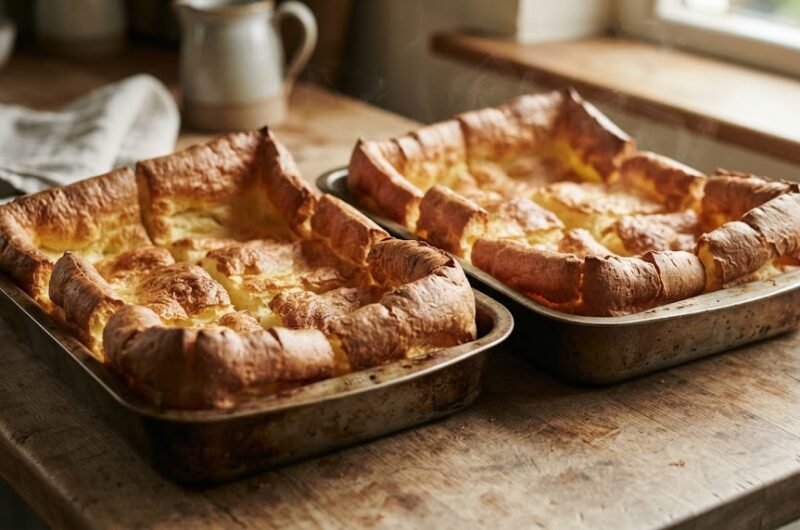
Delia Smith Yorkshire Pudding For 12 Recipe
Course: Side DishCuisine: British12
servings10
minutes30
minutes264
kcal40
minutesA classic Delia Smith-style Yorkshire pudding recipe carefully scaled to serve 12. The puddings are crisp, golden and well-risen on the outside, with a light, tender centre. They are ideal alongside a traditional roast dinner and are especially good with plenty of rich gravy.
Ingredients
350g (12.3 oz) plain flour
4 large eggs
350ml (11.8 fl oz) semi-skimmed milk
220ml (7.4 fl oz) water
160g (5.6 oz) beef dripping, or 8 tbsp flavourless vegetable or sunflower oil
Salt, to taste
Freshly milled black pepper, to taste
Directions
- Make the batter: Place the flour in a large mixing bowl and season with salt and freshly milled black pepper. Make a well in the centre, add the eggs and gradually whisk in the milk and water until you have a smooth, fairly thin batter.
- Prepare the tins: Divide the beef dripping or oil between two suitable flameproof roasting tins, each approximately 20 x 26cm. Place the tins in a preheated oven at 220°C / 200°C Fan / Gas Mark 7 / 425°F for about 10 minutes, until the fat is very hot.
- Add the batter: Carefully remove the hot tins. For the best rise, the fat should be smoking hot. Place each tin briefly over high heat on the hob if appropriate, then quickly divide the batter evenly between the two tins.
- Bake: Transfer the tins to the highest shelf of the oven. Bake for approximately 25–30 minutes, until the Yorkshire puddings are dramatically risen, crisp and deep golden brown.
- Keep the oven closed: Avoid opening the oven door while the puddings are cooking, as a sudden loss of heat can affect their rise and crispness.
- Serve immediately: Remove from the oven and serve straight away while the edges are crisp and the centres are light and tender.
Notes
- The batter does not need to be rested before cooking.
- Make sure the fat is extremely hot before adding the batter.
- Avoid opening the oven during baking.


