



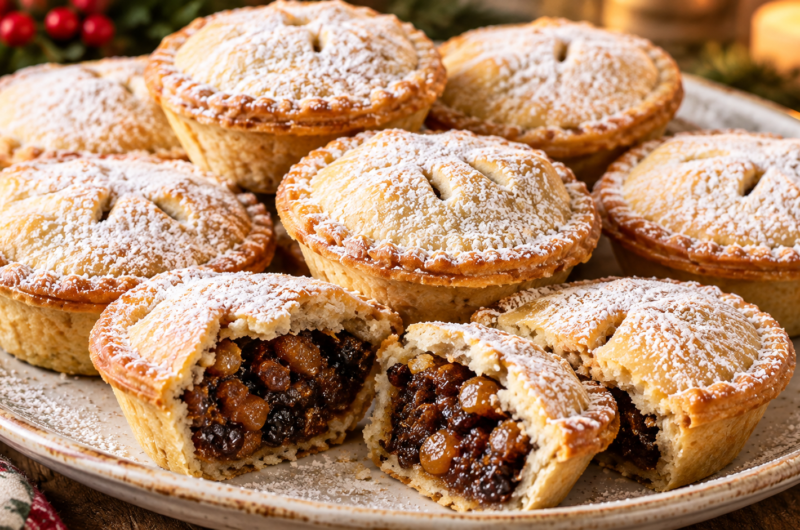
These Delia Smith mince pies are a classic British Christmas bake: thin, crisp shortcrust pastry wrapped around rich, fruity mincemeat, finished with a light dusting of icing sugar. The pastry uses a combination of butter and lard, giving the finished pies a particularly delicate, crumbly texture.
The recipe is associated with Delia Smith’s Christmas cooking and appears in Delia’s Happy Christmas, her 2009 festive cookbook containing 150 recipes alongside menu plans, shopping lists and Christmas planning advice.
Why You’ll Love This Mince Pies Recipe
There is a lot to like about these traditional mince pies, particularly if you prefer a pastry-led Christmas bake rather than a thick, cakey version.
- Crisp, crumbly pastry: Butter brings flavour while lard helps give the pastry a short, delicate texture.
- A generous fruit filling: The mincemeat provides the concentrated sweetness, spice and dried-fruit character associated with classic Christmas mince pies.
- Thin pastry matters: Rolling the dough finely keeps the pies light rather than making them heavy.
- A practical Christmas bake: The pies can be baked ahead and stored once completely cool.
- Simple finishing: A little milk on top and icing sugar after baking are all that is needed.
Recipe at a glance
- Makes: 22 mince pies
- Prep time: About 45 minutes, including chilling
- Bake time: 25–30 minutes
- Oven: 200°C / 400°F / Gas Mark 6
- Difficulty: Moderate
- Best served: At room temperature or gently warmed
Ingredients You’ll Need
For the pastry
- 321g plain flour (11.3 oz)
- 69g lard (2.4 oz)
- 69g butter (2.4 oz)
- 1 small pinch of salt
- Cold water, as needed to bring the pastry together
For the filling and topping
- 513g mincemeat (18.1 oz)
- A little milk, for brushing
- Icing sugar, for dusting
How to Make Traditional Delia Smith Mince Pies
1. Make the shortcrust pastry
Sift the flour into a large bowl and add the salt. Cut the cold butter and lard into small pieces, then rub them into the flour with your fingertips until the mixture looks evenly crumbly.
Work lightly rather than kneading. The aim is to coat the flour with fat without warming the mixture excessively.
Add cold water a little at a time until the crumbs just come together into a dough. Stop as soon as the bowl can be cleaned up by the dough; excess water can make shortcrust pastry tougher.
2. Chill the dough
Wrap the pastry or place it in a covered container and refrigerate for 20–30 minutes.
This resting period makes the dough easier to roll and helps prevent it from shrinking excessively during baking. It also gives the butter and lard time to firm up again after mixing.
While the pastry chills, heat the oven to 200°C / 400°F / Gas Mark 6 and lightly grease one or two shallow patty tins.
3. Roll and cut the pastry
Divide the chilled pastry into two portions. Roll the first portion out thinly on a lightly floured surface and cut 22 rounds measuring about 7.5cm (3 inches) across for the bases.
Gather the scraps carefully and re-roll them rather than discarding them.
Roll the remaining pastry and cut 22 smaller rounds of about 6cm (2½ inches) for the lids.
The pastry should be thin rather than bulky. This is one of the most important points for achieving delicate mince pies.
4. Fill the pastry cases
Fit the larger pastry rounds into the greased patty tins, pressing them gently into the hollows without stretching the dough.
Spoon the mincemeat into each case, keeping it level with the top of the pastry rather than heaping it up. Mincemeat expands and bubbles as it heats, so excessive filling can escape and burn against the tin.
5. Add the lids and prepare for baking
Lightly dampen the edge of each smaller pastry round with water, then place it over the filling. Press around the edge to create a good seal.
Brush the tops lightly with milk. Using clean kitchen scissors, make three small snips in each lid. These vents allow steam to escape and help prevent the tops from splitting unpredictably.
6. Bake, cool and finish
Place the pies towards the upper part of the oven and bake for 25–30 minutes, watching for a light golden colour.
Transfer the baked pies to a wire rack and allow them to cool. Once completely cool, sift icing sugar generously over the tops.
The pastry will firm as it cools, so resist the temptation to remove and handle the pies while they are piping hot.

Delia’s Kitchen Tips for Making the Recipe
Keep the pastry cool. Warm hands and a hot kitchen can soften the fat before the pastry reaches the oven. If the dough becomes sticky while rolling, return it to the refrigerator briefly.
Roll thinner than you think. Thick pastry can overwhelm the mincemeat. The aim is a delicate shell that is sturdy enough to hold the filling but crisp enough to crumble when eaten.
Don’t drown the cases in mincemeat. Keep the filling approximately level with the pastry edge. This reduces leakage and makes the pies easier to remove from the tin.
Use cold water sparingly. Add it gradually. Different flour absorbs different amounts, so there is no advantage in adding a fixed large quantity of water.
Watch the final minutes. The pies should be light golden rather than deeply brown. The top pastry can colour quickly in the hotter part of the oven.
Recipe Variations and Substitutions
The following are optional adaptations, not changes to the original recipe.
All-butter pastry
You can replace the lard with an equal weight of butter if you prefer not to use lard. Expect a richer, more buttery pastry with a somewhat different texture.
Vegetarian mince pies
The pastry itself is not vegetarian because it contains lard. To make a vegetarian version, replace the lard with a suitable vegetarian baking fat. Also check that your mincemeat does not contain animal suet.
Alcohol-free
Check the mincemeat label carefully. Some prepared and homemade mincemeats contain brandy or another spirit. Choose an alcohol-free mincemeat if necessary.
Orange pastry?
The original pastry does not require orange zest. You may find recipes described as Delia Smith orange pastry mince pies elsewhere, but orange zest should not be added if your aim is to reproduce this particular traditional pastry. If you want an orange-flavoured variation, a little finely grated orange zest can be incorporated as an optional adaptation.
What to Serve With Delia Smith Mince Pies
These mince pies are usually at their best with something cool and creamy alongside them.
Try them with:
- Brandy butter for a rich festive pairing
- Lightly whipped cream
- Thick double cream
- Vanilla ice cream
- Custard, particularly when the pies are served warm
- A cup of tea or coffee
For a more indulgent Christmas dessert, you can serve a warm mince pie with a scoop of vanilla ice cream.

If you are putting together a wider selection of Christmas desserts, another useful option from the site’s recipe collection is these little sticky toffee puddings, which can provide a warmer, sauce-based alternative to the fruit-filled mince pies.
These mince pies also work well alongside other festive bakes such as a traditional Yule log or chocolate chestnut log.
Are Delia’s Mince Pies Gluten-Free, Vegan or Dairy-Free?
This traditional recipe is not vegetarian, because it uses lard, and it is not vegan or dairy-free, due to the butter and milk glaze. It also contains gluten from the plain flour.
Here’s how to adapt it:
- To make it vegetarian: replace the lard with an equal quantity of butter or a vegetarian block fat, and check your mincemeat’s packaging, as some brands use beef suet.
- To make it vegan: use a plant-based block butter in place of both the butter and lard, brush with a plant-based milk instead of dairy milk, and choose a vegan-certified mincemeat.
- To make it dairy-free: swap the butter for a dairy-free block butter and use plant-based milk for glazing.
- To make it gluten-free: use the gluten-free flour adaptation noted in the variations section above, and confirm your mincemeat doesn’t contain any gluten-based thickeners.
Nutrition Information
The following is an approximate estimate per mince pie, based on the revised 22-pie quantity and typical nutritional values for plain flour, butter, lard and prepared mincemeat.
- Calories: about 190 kcal
- Protein: about 2.5g
- Carbohydrates: about 29g
- Fat: about 8g
- Fibre: about 2g
- Sugar: about 15g
- Salt: about 0.15g
Actual nutrition will vary considerably according to the brand and recipe of the mincemeat, the amount of icing sugar used and how much milk is brushed onto the pastry.
Common Mistakes to Avoid
- Tough, hard pastry. This almost always comes from overworking the dough or adding too much water. Mix gently and stop as soon as it comes together.
- Leaking, sticky pies. Usually caused by overfilling. Fill to the level of the pastry rim, not above it.
- Shrunken pastry cases. This happens if the dough isn’t rested before baking. Don’t skip the chilling step.
- Pale, underbaked tops. If your oven runs cool or your pies are positioned too low, the pastry can stay pale rather than turning golden. Position the tins near the top of the oven.
- Soggy bottoms. Make sure your mincemeat isn’t warm when it goes into the pastry cases, and don’t skip greasing the tins properly.
Can You Make This Recipe Ahead?
Yes. These mince pies are well suited to advance preparation.
You can make the pastry earlier in the day and keep it refrigerated until ready to roll. You can also assemble the pies before baking and refrigerate them for a short period, provided they remain properly chilled.
For Christmas entertaining, baking the pies a day or two before serving is particularly convenient. Allow them to cool completely before storing.
If you want to serve them warm, reheat them gently rather than subjecting them to prolonged high heat, which can dry the pastry.

Storage and Reheating
Once completely cool, keep the mince pies in an airtight container in a cool, dry place. Separating layers with baking paper can help prevent them from sticking together.
For longer storage, mince pies can be frozen. Freeze them once cool in a suitable airtight freezer container, protecting them from freezer odours and moisture. Defrost them thoroughly before serving.
To restore some crispness, place thawed pies in a moderate oven for a short period until warmed through. Avoid microwaving if crisp pastry is your priority, as microwave heating can soften the crust.
If the pies contain homemade mincemeat, follow the storage guidance for that particular mincemeat as well.
Meal Prep
These mince pies are more useful for batch preparation than everyday meal prep.
The most efficient approach is to make a full batch, allow the pies to cool completely and store them in an airtight container. They can then be served individually throughout the festive period.
For larger Christmas gatherings, freezing part of the batch is useful. Keep the pies well protected and thaw only the quantity you expect to serve.
Frequently Asked Questions
Can I freeze these mince pies?
Yes. Once cooled, freeze them in a well-sealed freezer-safe container. Defrost thoroughly before serving and warm briefly in the oven if you want to refresh the pastry.
Why did my mince pie pastry turn out tough?
The most common reasons are too much water, overworking the dough or rolling and handling it excessively. Bring the pastry together gently and use only enough cold water to form a dough.
Why did the mincemeat leak out?
Usually, the case was overfilled or the lid was not sealed securely. Keep the mincemeat level with the pastry edge and press the dampened lid firmly around its perimeter.
Can I use all butter instead of lard?
Yes, as an adaptation. The original style uses both butter and lard, but an all-butter pastry can be used if preferred. The texture will be somewhat different.
Can I make these mince pies vegetarian?
Yes. Replace the lard with a suitable vegetarian baking fat and make sure the mincemeat itself contains no animal suet.
Can I make a vegan version?
Yes, with adaptations. Use vegan baking fat instead of butter and lard, plant milk instead of dairy milk, and vegan mincemeat. Check every packaged ingredient carefully.
Can I make Delia Smith shortcrust pastry for mince pies without lard?
You can, but replacing the lard changes the original pastry. An all-butter version is the simplest alternative, while a suitable vegetarian or vegan shortening can also be used.
How do I know when the mince pies are done?
Look for pastry that is lightly golden across the top and edges. At the stated oven temperature, this generally takes about 25–30 minutes, although individual ovens vary.
What can I serve with traditional mince pies?
Cream, custard, brandy butter or vanilla ice cream all work well. Warm mince pies are especially good with a cool accompaniment, while completely cooled pies are ideal with tea or coffee.
Can I double the recipe?
Yes. If you need a larger batch, scale every ingredient proportionally rather than increasing only the mincemeat or pastry. Work with multiple batches if your equipment or workspace makes a double quantity difficult to handle.
Conclusion
Delia Smith’s mince pies recipe is a straightforward expression of traditional Christmas baking: crisp shortcrust pastry, rich mincemeat, a light golden finish and a final snowfall of icing sugar.
The butter-and-lard pastry is the detail that gives the recipe much of its character, while careful chilling, thin rolling and restrained filling make the biggest difference to the finished pies. Make them ahead for Christmas visitors, freeze a batch for later or serve them warm with cream or ice cream for a simple festive dessert.
Delia Smith Mince Pies Recipe
Course: DessertCuisine: British22
servings40
minutes30
minutes300
kcal1
hour10
minutesThese traditional mince pies combine rich, crumbly shortcrust pastry with a generous filling of festive mincemeat. They are finished with a light milk glaze, baked until golden, and dusted with icing sugar for a classic Christmas treat.
Ingredients
For the pastry
321g plain flour (11.3 oz)
69g lard (2.4 oz)
69g butter (2.4 oz)
1 small pinch of salt
Cold water, as needed to bring the pastry together
For the filling and topping
513g mincemeat (18.1 oz)
A little milk, for brushing
Icing sugar, for dusting
Directions
- Make the pastry: Sift the flour and salt into a large bowl. Rub in the cold lard and butter with your fingertips until the mixture resembles fine breadcrumbs.
- Bring the dough together: Add cold water a little at a time, mixing gently until you have a soft but firm dough. Avoid adding more water than necessary.
- Chill and roll: Wrap the pastry and chill for 20–30 minutes. Roll it out on a lightly floured surface. Cut rounds for the bases and slightly smaller rounds for the lids.
- Fill the pies: Line a mince pie tin with the pastry bases. Add a level spoonful of mincemeat to each, taking care not to overfill. Place a pastry lid on each pie and press the edges gently to seal.
- Prepare for baking: Brush the tops lightly with milk. Make three small cuts in each lid to allow steam to escape.
- Bake: Bake at 200°C (400°F), Gas Mark 6, for 25–30 minutes, or until the pastry is lightly golden. Allow the mince pies to cool before dusting with icing sugar.
Notes
- Keep the butter, lard and water cold for a crisp, short pastry.
- Do not overfill the pies, as the mincemeat can bubble over during baking.
- Let the pies cool slightly before removing them from the tin.


